Last updated October 15, 2026
The Complete Guide to ADU in Santa Clarita
Santa Clarita straddles two separate permitting jurisdictions – the City of Santa Clarita and unincorporated Los Angeles County – and which side of that invisible line your property sits on can change your timeline by four to six months. Most ADU guides ignore this entirely. They recycle the same generic California ADU advice you can read anywhere, which means a homeowner in Canyon Country gets the same guidance as someone in Valencia, even though their permit paths run through different agencies with different fee schedules and different plan-check backlogs. This guide maps every stage of an ADU project to Santa Clarita’s actual rules, costs, and conditions, and you can find more guides & resources on our blog. By the time you finish reading, you’ll know what your property can support, what it will cost, which approvals you need, and how long each stage realistically takes here – not in San Diego, not in Sacramento, here.
Quick Answer
An ADU in Santa Clarita typically costs between $180,000 and $320,000 for a detached unit before site work, takes 9 to 18 months from design to certificate of occupancy, and requires either City of Santa Clarita or LA County approval depending on your parcel’s jurisdiction. A garage conversion runs lower – roughly $80,000 to $150,000 – because the shell already exists, while a room addition in Santa Clarita lands somewhere between those two ranges. The fastest path to approval is a pre-approved or plan-check-ready design product, which removes the longest variable from the process.
Table of Contents
- How Jurisdiction Works in Santa Clarita – and Why It Changes Everything
- What ADUs Actually Cost in Santa Clarita
- ADU Types: Detached, Attached, Garage Conversion, and Prefab
- What Santa Clarita HOAs Can and Cannot Block
- Utility Connections: SCE, SoCal Gas, and the LADWP Wrinkle
- The Staged Decision Framework: Feasibility to Contractor Selection
- Common Mistakes to Avoid
- When to Call a Professional
How Jurisdiction Works in Santa Clarita – and Why It Changes Everything
Santa Clarita is one city with two different permitting worlds. The incorporated City of Santa Clarita covers most of the valley floor and the major planned communities: Valencia, Newhall, Saugus, Canyon Country, and the newer developments near Golden Valley and Tesoro del Valle. But a surprisingly large portion of what people call “Santa Clarita” – especially the areas north of the 14, parts of Sand Canyon, Placerita Canyon, Agua Dulce, and the communities threaded through the foothills – is unincorporated Los Angeles County. If your mailing address says Santa Clarita but your property taxes reference LA County assessor records without a city tax line, you may fall under county jurisdiction.
The practical differences are real. The City of Santa Clarita runs its own building department with, in our experience, faster plan checks and more predictable timelines for ADUs because the city has processed a high volume of them since the 2020 state law changes. LA County handles a broader geographic area with a heavier caseload, which generally means longer review queues. A plan check that takes six weeks in Santa Clarita proper can take three to four months in county jurisdiction. That’s not a criticism – it’s a volume problem – but it changes your project calendar before you’ve even bought a set of plans.
To determine which jurisdiction governs your parcel, check your most recent property tax bill or search your address on the LA County Assessor portal. If your tax bill shows a city line item for Santa Clarita, you’re in the city. If it doesn’t, you’re likely in unincorporated county territory. This one determination should be your first step, before you sketch a floor plan or call an ADU builder in Santa Clarita, because it determines which forms you’ll file, which fee schedule applies, and which inspectors will show up on your property.
What ADUs Actually Cost in Santa Clarita
Santa Clarita’s labor market sits between the pricier LA Basin and the cheaper Antelope Valley, and that lands ADU costs in a specific band. We’ve seen enough local projects to give you real ranges instead of national averages, which are useless for decision-making.
- Detached ADU (500 – 800 square feet): $180,000 – $320,000 before site work. This assumes a one-bedroom or two-bedroom layout with a kitchen and bath, built on a conventional slab or raised foundation. Site work – grading, retaining walls, utility trenching, tree removal – adds $15,000 – $45,000 depending on your lot.
- Garage conversion (400 – 600 square feet): $80,000 – $150,000. The shell, foundation, and roof already exist, so the money goes into insulation, drywall, electrical, plumbing, and a new exterior finish. The wide range reflects how much remediation your garage needs – some in older Newhall and Saugus neighborhoods predate modern foundation standards.
- Attached ADU (addition connected to the primary home): $150,000 – $260,000. You share one wall and often share some utility runs, but Santa Clarita’s hillside lots can make foundation work more expensive than flat-ground detached builds.
- Prefab ADU product (Dvele, Plant Prefab, Boxabl): $150,000 – $400,000 total installed. The product itself is typically $80,000 – $250,000, but you still pay for foundation, utility hookups, and site work, which run $50,000 – $150,000 in Santa Clarita depending on slope and access.
These ranges reflect 2025 – 2026 material costs. Lumber, steel, and concrete have stabilized somewhat from the spikes of 2021 – 2022, but the real variable in Santa Clarita is entitlement. A flat lot in a standard subdivision with an available sewer lateral will always cost less than a hillside parcel requiring a retaining wall and a grinder pump. Before you commit to a number, know your lot conditions.
ADU Types: Detached, Attached, Garage Conversion, and Prefab
The four ADU types are not interchangeable. Each one matches a different property condition and budget profile, and choosing wrong costs more than choosing late.
Detached ADU
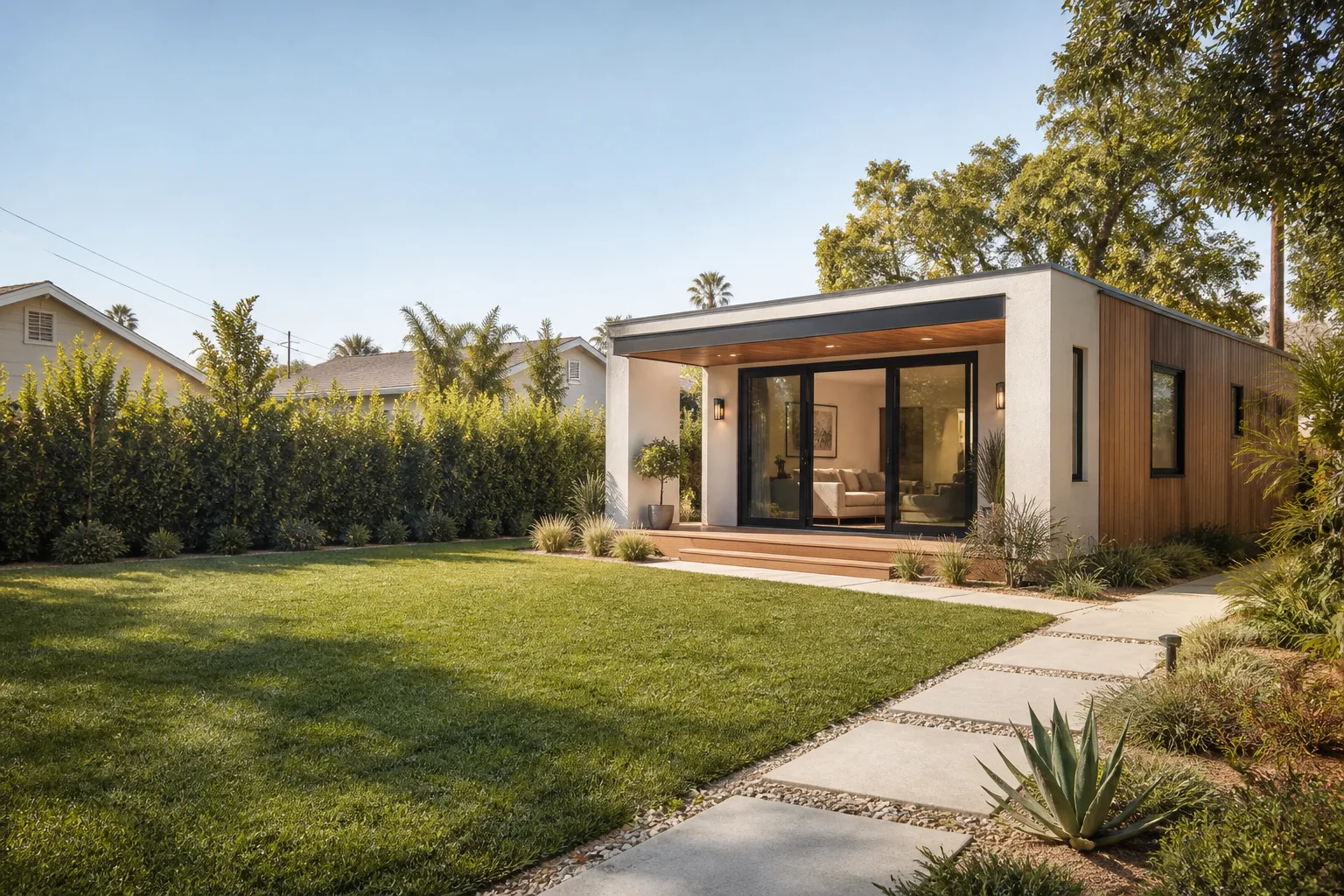
A standalone unit in your backyard – separate walls, separate roof, full kitchen and bath. This is the most flexible type for Santa Clarita’s typical suburban lots, which often measure 6,000 to 10,000 square feet. You’ll need to respect setback rules (the required gap between your new structure and the property line), which in Santa Clarita typically means 4-feet side and rear setbacks for ADUs under state default rules, though your specific zoning may vary. For families who want separation – an aging parent, an adult child, or a rental unit – the detached ADU provides true independence. It’s also the highest-cost option per square foot because every element is new.
Attached ADU
An addition that shares a wall with the main house, sometimes created by converting an existing wing or building onto a side yard. A home addition contractor in Santa Clarita will tell you the same thing we will: attached units can share some utility runs and HVAC if the primary system has capacity, which trims mechanical costs. The tradeoff is privacy – both for you and for the ADU occupant – and the design constraint of matching your existing roofline and exterior.
Garage Conversion
The workhorse of ADU value in Santa Clarita. Your garage already has foundation, walls, and a roof. Converting it into living space is the fastest path to a legal rental or family suite, and it preserves your backyard for other uses. California law since 2020 requires cities to approve ADU permits for garage conversions even if you don’t replace the parking space, which removed the biggest old objection. The caveat: some older garages in Newhall and Saugus have slab foundations that don’t meet current moisture-barrier or seismic standards, which means the “cheap conversion” can turn into a more involved foundation remediation.
Prefab and Modular ADUs
Factory-built units delivered to your lot and set on a prepared foundation. The honest tradeoff: you trade some design flexibility for construction speed. A panelized product like Dvele or a volumetric factory line like Plant Prefab or Boxabl can cut on-site construction time dramatically, which matters if you’re trying to get a rental unit generating income by a specific date. Santa Clarita’s access constraints matter here – some hillside lots and gated communities can’t accommodate crane delivery or large flatbed trucks, which can eliminate certain prefab makers from consideration. We work with several product lines and can tell you early in the process whether your lot works for prefab or needs stick-built.
What Santa Clarita HOAs Can and Cannot Block
Santa Clarita has one of the highest concentrations of HOA-governed neighborhoods in Southern California. Valencia alone contains dozens of associations, each with its own CC&Rs, architectural review committees, and older rules that predate modern ADU law. This creates real confusion, and it’s worth being blunt about what an HOA can and cannot do under current California law.
Since 2020, the California ADU reform statutes are explicit: an HOA cannot prohibit the construction of an ADU or JADU (junior accessory dwelling unit) on a single-family lot. HOA CC&R provisions that outright ban ADUs are unenforceable. That’s state law – not a courtesy, not a negotiation. Your HOA’s 1997 ban on second units is legally dead.
What the HOA can still regulate is the architectural appearance. Your association can require that the ADU’s exterior colors, materials, and general massing be consistent with the community’s original design standards, provided those standards don’t have the effect of making the ADU infeasible. An HOA can also enforce reasonable rules about construction hours, contractor parking, and neighbor notifications during the build. In practice, some Santa Clarita HOAs have tried to slow-walk ADU applications through architectural review as a de facto veto. If you encounter this, California’s Housing Accountability Act and Civil Code section 4751 generally preempt those efforts, but enforcement may require a demand letter from an attorney. For most homeowners, the pragmatic path is to submit the HOA application early in the process – before you lock in a design – and keep the paperwork trail in writing, especially with HOAs in the Valencia and Northbridge communities where architectural review committees are most active.
Utility Connections: SCE, SoCal Gas, and the LADWP Wrinkle
Utility hookup timelines are the least-discussed variable in ADU projects, and they consistently surprise homeowners in Santa Clarita. Here’s what you need to know about the three utility realities affecting ADU builds in this city.
Southern California Edison serves most of Santa Clarita. A straightforward ADU electrical service upgrade – typically requiring a second panel or a subpanel run – usually takes 4 to 8 weeks from application to energization, but SCE’s Santa Clarita service area has seen longer lead times for transformer upgrades on infill lots. If your ADU pushes your property’s load calculation above existing transformer capacity, you can wait 3 to 6 months for SCE to schedule equipment work. That’s a hard timeline constraint no builder can waive.
SoCal Gas serves the valley floor and most of the incorporated city. Gas line work for an ADU is generally faster than electrical – 3 to 6 weeks – because new gas-only ADUs are a smaller load addition. But if you’re in the county portions of Santa Clarita’s hillsides, your gas service may be propane, which isn’t a utility connection at all: it’s a regulated tank installation with its own site requirements and fire district setbacks.
The LADWP wrinkle is different. Los Angeles Department of Water and Power serves a few slivers of territory in and around Santa Clarita’s edges, particularly annexation remnants and some county pockets. If your parcel is LADWP (check your electric bill), your ADU electrical application runs through a different process with different timeframes and different fees than SCE customers. We’ve seen LADWP-served lots in the Santa Clarita area take 2 to 3 months just for the service connection stage. Knowing your utility territory before you file plans can prevent a schedule collision.
The Staged Decision Framework: Feasibility to Contractor Selection
Most ADU projects fail because the homeowner starts with the wrong question – “Which builder should I hire?” – instead of “What does my lot actually support?” If you’re unsure where to begin, read our How to Hire a ADU Contractor in Santa Clarita: A Step-by-Step Guide first. The correct sequence matters. Here is the staged framework we walk every Santa Clarita client through, with go/no-go criteria at each stage.
- Jurisdiction check: Determine whether you’re in City of Santa Clarita or unincorporated LA County jurisdiction. Go: you know which agency will review your plans. No-go: you don’t, and you’re already guessing.
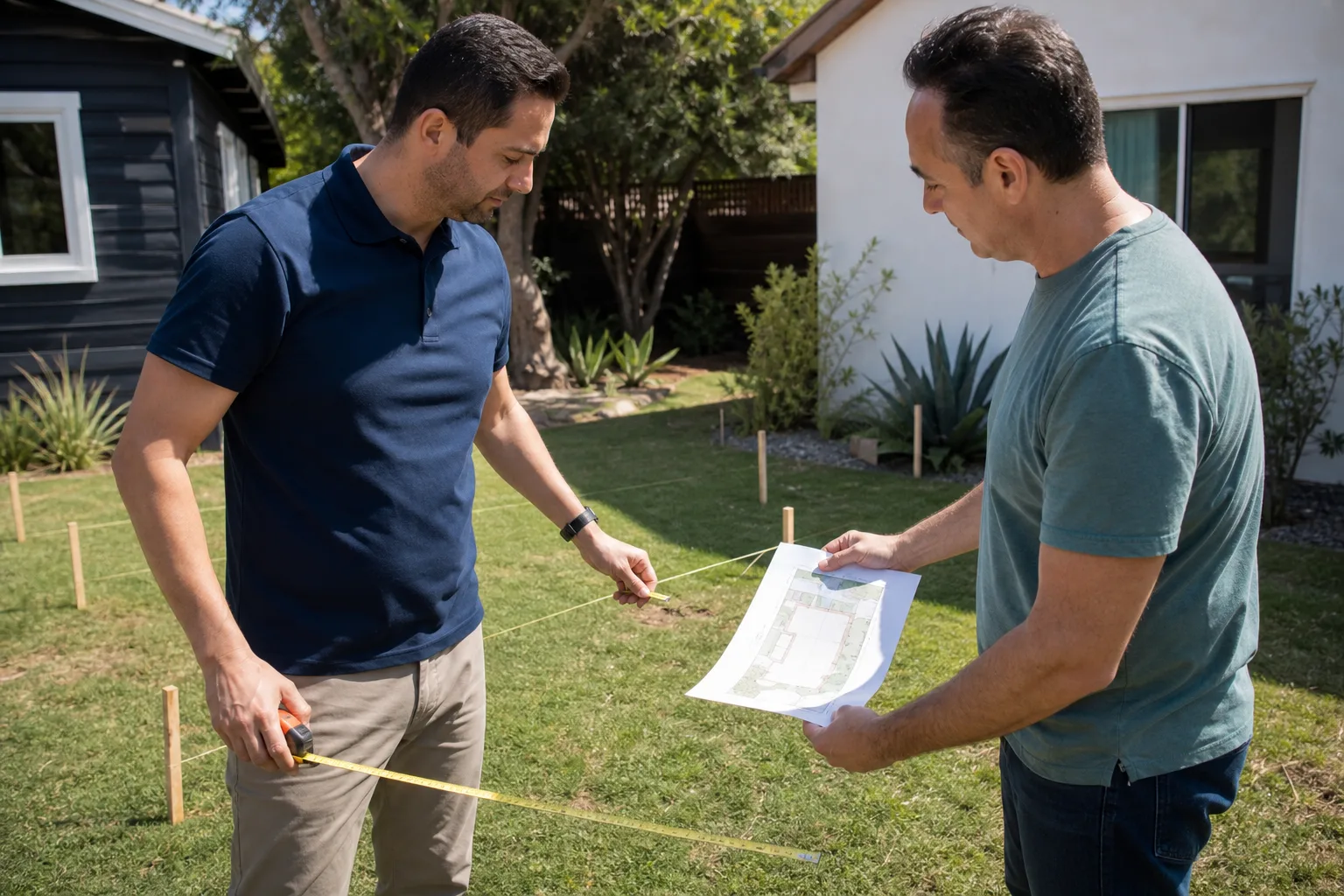
- Lot feasibility: Measure your buildable area, check setbacks, note grade changes, identify utility easements, and confirm sewer versus septic. In Santa Clarita, many hillside lots have septic systems that cannot legally accept ADU plumbing without a costly upgrade. Go: the physical footprint and utility path are clear. No-go: the site has a septic constraint, no buildable flat area, or utility access that would require crossing a neighbor’s property.
- Design type selection: Choose detached, attached, garage conversion, or prefab based on your budget and use case. Go: the type matches your lot and your budget band. No-go: you’re trying to force a detached unit onto a lot that really can only fit a garage conversion.
- Permit path mapping: Identify your entitlement strategy – ministerial approval under state ADU law, or a discretionary path if your lot has unusual conditions. Go: your project qualifies for by-right approval under Senate Bill 9 and ADU statutes. No-go: the jurisdiction indicates an exception applies that will require a discretionary hearing, which adds 3 to 6 months.
- Contractor selection: Choose a builder who shows you a written price before work begins, staffs your project with named, verified people, and puts a workmanship guarantee in writing. Go: the price is fixed, the crew is identified, the promise is documented. No-go: the estimate is vague, the crew is unnamed, or the warranty is verbal.
The five stages work together, and skipping stage two is the most expensive shortcut in ADUs. A $250,000 ADU on a lot that actually required $60,000 in unsaid site work is not a $250,000 ADU – it’s a $310,000 one that started with a bad feasibility read. That’s why every Sutton ADU Santa Clarita project begins with a written assessment of the site before we quote a number. The quotation follows the feasibility, never the other way around. For more on how we structure the build itself, see our room addition contractor in Santa Clarita page, which covers the same philosophy applied to additions.
Common Mistakes to Avoid
- Starting with the builder instead of the jurisdiction. You’ll waste weeks comparing contractors who all operate under the same unknown permit timeline. Find out if you’re City or County first. In Santa Clarita, this one fact changes your schedule by months.
- Trusting a national cost calculator. A $150,000 ADU cost average from a national website doesn’t reflect Santa Clarita labor rates, hillside grading costs, or our utility hookup timelines. Local numbers only.
- Assuming the HOA can’t do anything. State law protects your right to build, but an HOA architectural review can still delay you if you submit late. Start the HOA process early and keep it in writing.
- Forgetting the utility lead time. SCE transformer upgrades and LADWP service connections are not same-month processes. Applying for utility service after you break ground is a schedule error that carries real cost.
- Confusing prefab with “cheap.” Factory-built units cut construction time, not necessarily cost. The product is a smaller share of your total budget than you’d expect once foundation, site work, and hookups are priced in.
- Accepting a vague estimate. “Approximately $220,000” is not a price. It’s a starting point for change orders. Demand a written price before work begins, and walk away from anyone who won’t provide one.
- Designing before the feasibility read. Falling in love with a detached 800-square-foot layout, then discovering your lot only supports a 500-square-foot garage conversion, is a $5,000 to $10,000 design mistake. Feasibility first, design second.
When to Call a Professional
You can determine your jurisdiction, research costs, and sketch a rough layout on your own. Where professional help becomes necessary is the point where site conditions interact with building code, utility capacity, and structural work. If your lot has any grade change over three feet, an existing septic system, constrained access, or a utility easement crossing the build area, you need a builder who’s walked Santa Clarita sites, not a generic plan house. If you’re considering a prefab line like Dvele, Mighty Buildings, or Boxabl, you need someone who can honestly assess whether your lot can accept a factory-built unit at all. Sutton ADU Santa Clarita offers free estimates in Santa Clarita – call (661) 430-0429 – and every estimate begins with a written site assessment before we quote a number. We’d rather tell you your lot doesn’t work than sell you a project that will.
Frequently Asked Questions
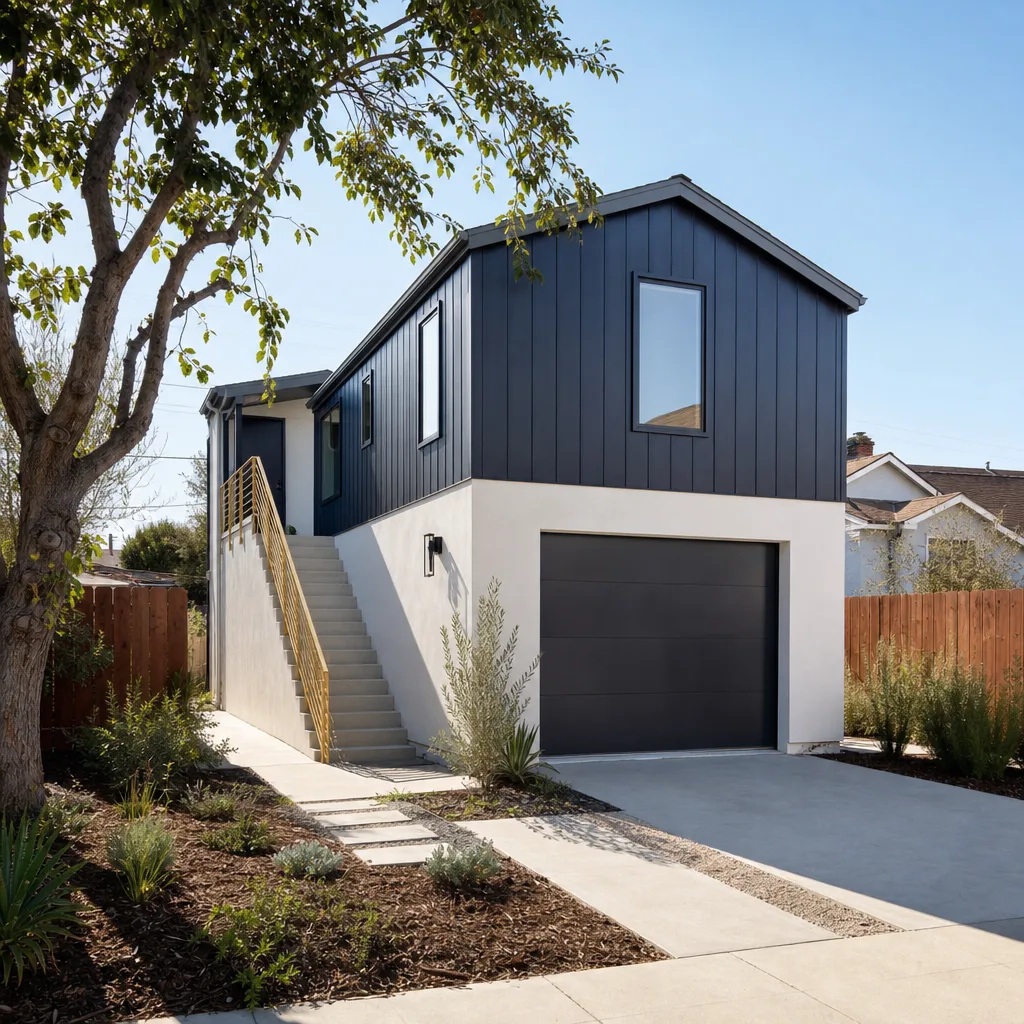
A detached ADU in Santa Clarita typically costs $180,000 to $320,000 before site work, while a garage conversion runs $80,000 to $150,000 and an attached addition runs $150,000 to $260,000. Site work – grading, retaining walls, utility trenching – is separate and typically adds $15,000 to $45,000. Call (661) 430-0429 for an exact written quote – estimates are free.
Expect 9 to 18 months from initial design to certificate of occupancy in Santa Clarita. City of Santa Clarita jurisdiction projects tend toward the shorter end of that range, while LA County jurisdiction projects often land toward the longer end due to plan-check volume. Prefab products can trim on-site construction time by 3 to 5 months, but permit and utility timelines remain unchanged.
No. Since the 2020 California ADU reform statutes, HOAs in Santa Clarita cannot prohibit an ADU on a single-family lot, and any CC&R ban on second units is unenforceable. Your HOA can regulate exterior appearance and construction logistics, but it cannot block the project itself. Start the HOA review early and keep all correspondence in writing.
Prefab makes sense for flat lots with good access and a need for speed on the construction timeline. Products from Dvele, Plant Prefab, and Boxabl can shorten on-site work significantly, but Santa Clarita’s hillside lots and gated communities often can’t accommodate crane delivery or large flatbeds. A good builder will tell you honestly in the first site visit whether prefab works for your lot or whether stick-built is the better route.
Most ADUs in Santa Clarita require at least a subpanel, and many older homes need a full service upgrade to 200 amps. If your street transformer lacks capacity, SCE may need to schedule equipment work, which can take 3 to 6 months. Apply for your electrical service early – this is not a same-month process.
Not if you have a written, fixed price before construction begins. The Sutton ADU Santa Clarita standard is a written price before any work starts, with no surprise invoices and no scope creep passed silently to the bill. If the site reveals an unforeseen condition, we document it and price it before proceeding – never after the fact.
Written by Miles Hartwell, Owner at Sutton ADU Santa Clarita home, serving Santa Clarita since 2006.